Project Status#
This documentation targets OpenRath v2.0.0, the current Stable release. The durable Runtime and Agent Server form the current release surface while the v1 Python façade remains available.
@step / @router
       |
       v
ExecutionPlan -> Run -> Event -> Checkpoint
       |                          |
       +--> SQLite               +--> Interrupt / Effect ledger
       +--> PostgreSQL + Redis + S3-compatible artifacts
                                  |
                                  v
                         tenant-scoped Agent Server
v2.0.0 Capabilities#
Layer |
Status |
What it provides |
|---|---|---|
Workflow definition |
Implemented |
Explicit |
Durable execution |
Implemented |
Runs, Events, Checkpoints, Interrupts, retries, leases/fencing, cancellation, and effect reconciliation are present. |
Embedded storage |
Available |
SQLite provides a self-contained local durable store. |
Service storage |
Available |
PostgreSQL stores durable state; Redis provides optional signaling; S3-compatible storage holds artifacts. |
Agent Server |
Available |
Versioned |
Authorization |
Built in |
Explicit action grants and tenant/project-scoped objects protect service resources. |
Migration |
Available |
v1 JSONL Sessions can be imported into the v2 history model. |
See the v2 overview and operations guide for deployment guidance.
v1 Compatibility Baseline#
The v1.3.0 façade remains supported in v2.0.0. It is a usable multi-agent, multi-session runtime with first-class memory, internal async execution, optional LiteLLM routing, dynamic selection, and opt-in static workflow compilation. The sections below describe that compatibility surface.
Core model          Runtime path          Durability layer        Project quality
Session/Workflow -> async loop + tools -> persistence/config  ->  CI/docs/examples
Backend/Memory      local/OpenSandbox     local JSON/JSONL        Ruff + Actions
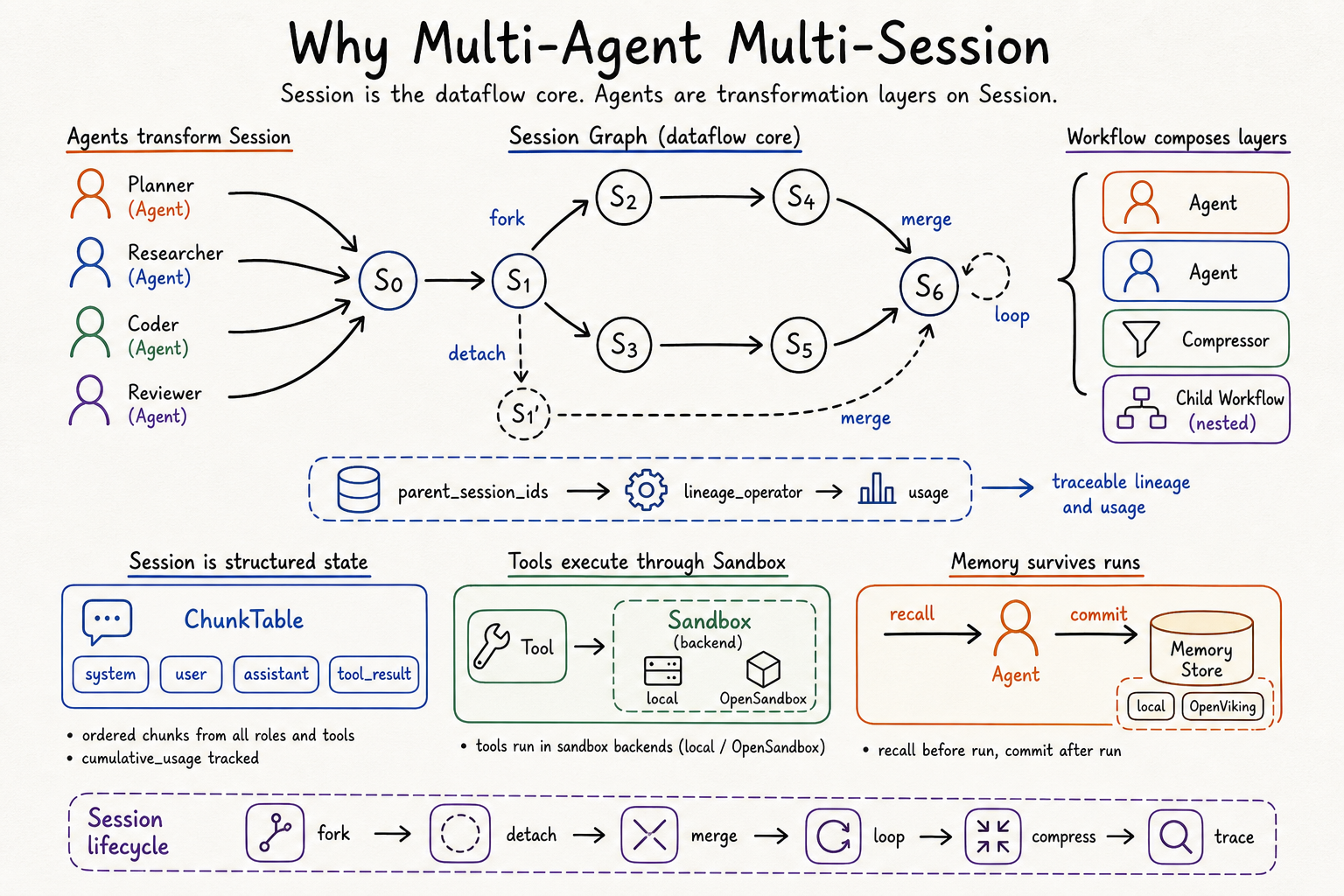
The runtime treats multi-agent and multi-session flows as first-class session graph operations.#
v1 Compatibility Capabilities#
Layer |
Status |
What this means |
|---|---|---|
Session core |
Implemented and central |
|
Workflow API |
Implemented |
Module-tree registration, dynamic |
Tool runtime |
Implemented |
|
Memory plane |
Implemented |
Local memory is in the base install; OpenViking is optional; agents expose remember / recall / commit APIs. |
Local backend |
Available |
Local command, file, and code payloads are supported and covered by conformance tests. |
OpenSandbox backend |
Integrated |
Current image defaults and targeted retries provide stable sandbox lifecycle behavior. |
LLM providers |
Expanded |
OpenAI-compatible and Anthropic adapters are core; optional LiteLLM adds broader provider routing; embedding and VLM clients are available. |
Streaming |
Implemented for compatible clients |
|
Async runtime |
Implemented internally |
Public calls stay synchronous; returned sessions may lazily synchronize transcript and usage fields. |
Persistence |
Implemented |
Session JSONL, shared atomic writes, root manifest, credentials sidecar, and dry-run-first GC cover cross-plane foundations. |
MCP integration |
Stdio integration available |
Stdio MCP tools can be wrapped as |
CI and lint |
In place |
Ruff, pre-commit, pytest-xdist, timeout/rerun plugins, and GitHub Actions cover lint, tests, shellcheck, OpenSandbox, and OpenViking paths. |
Documentation |
Included in v2.0.0 |
API reference and tutorials cover the retained façade’s compile, Provider placement, config/credentials, persistence, and current OpenSandbox behavior. |
Core Building Blocks#
These areas are the current foundation of the project:
Capability |
Evidence in repo |
|---|---|
Session state model |
|
Workflow composition |
|
Backend abstraction |
|
Memory abstraction |
|
LLM request/response DTOs |
|
OpenAI-compatible client path |
|
Core tutorials/examples |
|
Test coverage shape |
|
The repository includes focused test coverage across session behavior, backends, provider adapters, persistence, MCP, and conformance, providing a well-tested foundation for application development.
v1.3 Runtime Additions#
The v1.3.0 line adds inspection, placement, and persistence foundations on top of v1.2.2 runtime robustness:
Area |
Runtime change |
|---|---|
Memory plane |
|
Provider ecosystem |
Registry-based dispatch through |
Embedding and VLM |
|
Config |
LLM/MCP/memory/backend schemas, |
Internal async runtime |
|
Session persistence |
Append-only JSONL writer/loader with WAL partials, crash detection, and resumable pairs. |
Sandbox persistence |
Local workspace and OpenSandbox remote identity registry. |
Sandbox lifecycle |
Refcounted live handles shared by loop outputs, forks, detaches, and merges, with lock-protected acquire/release. |
Merge primitive |
|
Streaming loop |
|
MCP tools |
Stdio MCP servers can be exposed to the loop as normal |
LLM resilience |
Retry policy, credential fallback, token usage accounting, and budget guardrail. |
Dynamic routing |
|
Session ergonomics |
|
Runtime hardening |
Same-path file operations serialize, truncated compression raises, lazy sandbox first-open is locked, and the session registry uses weak references. |
Static compile |
Module-tree traversal builds |
Provider placement |
AgentParam, direct Workflow agents, and Sessions support |
Persistence foundation |
Shared atomic replace, config/backend/memory layout manifest, and dry-run-first cross-plane GC. |
OpenSandbox stability |
Current image/entrypoint, longer create budgets, targeted code-run retries, and safer stdout retry rules. |
Example ladder |
|
Project operations |
Ruff, pre-commit, pytest-xdist, timeout/rerun plugins, and split GitHub Actions matrices. |
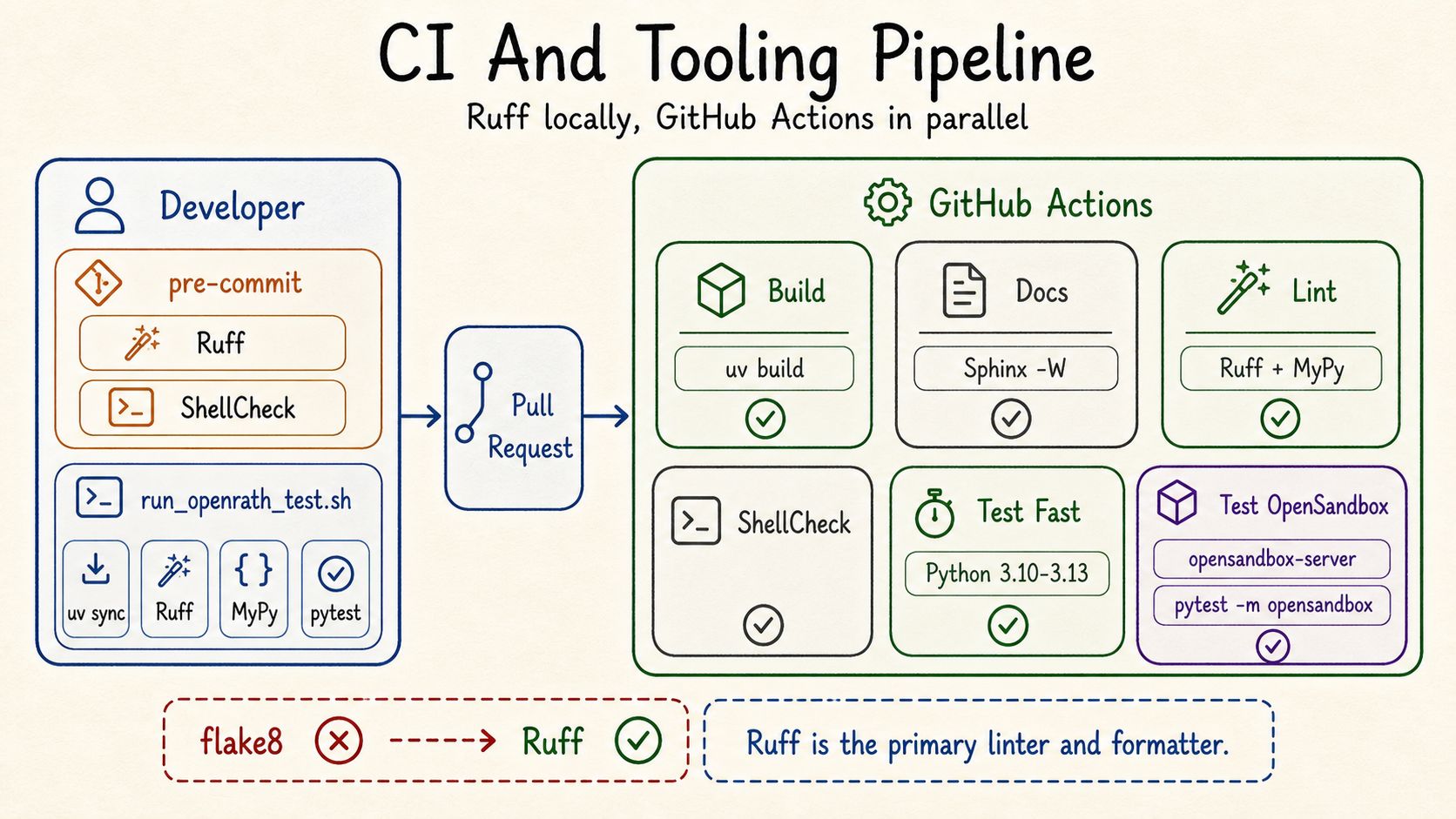
The current contributor path is guarded by Ruff, type checks, tests, docs builds, and GitHub Actions workflows.#
Practical Interpretation#
For a new user:
OpenRath is ready to try for local agent workflows, structured session experiments, custom tools, local memory, and provider integration work.
It is especially useful if you want session state, tool execution, and workflow composition to be explicit Python objects.
For service deployments, use the operations guide to configure storage, credentials, sandbox lifecycle, observability, backup, and recovery.
For a contributor:
Contributor entry points include runtime execution, persistence, provider adapters, sandbox integrations, memory, examples, and documentation.