OpenRath#
Stable release · OpenRath v2.0.0
Durable, explicit multi-agent execution.
OpenRath v2 compiles explicit workflow steps into immutable plans, then persists Runs, Events, Checkpoints, Interrupts, and effect outcomes across worker restarts. The v1 Session and Agent façade remains available in v2.0.0.
from pathlib import Path
from uuid import uuid4

from rath.context import RunContext
from rath.definition import EffectClass, step
from rath.flow import Workflow
from rath.runtime import LocalRuntime, SQLiteRunStore
from rath.session import Session


class DurableHello(Workflow):
    @step(entry=True, effects=EffectClass.READ_ONLY)
    def finish(self, state, context):
        return {**state, "message": "hello from OpenRath v2"}

    def forward(self, session: Session) -> Session:
        return session


store = SQLiteRunStore(Path("openrath.db"))
runtime = LocalRuntime(store)
run = runtime.submit(
    DurableHello(),
    session_id=uuid4(),
    context=RunContext.local(revision_id=uuid4()),
)
completed = runtime.work_once(worker_id="local-worker")
print(completed.status, completed.state)
The embedded path provides local durable execution with SQLite. Agent Server deployments use PostgreSQL, explicit action grants, governed adapters, a durable audit sink, and optional Redis and S3-compatible services.
Where To Start#
Path |
Use it for |
Entry |
|---|---|---|
v2 quickstart |
Install the v2.0.0 release wheel and run one durable workflow with SQLite. |
|
v2 operations |
Configure storage, rollout, incident, and recovery boundaries. |
|
Migration |
Bring v1 JSONL Sessions into the v2 history model. |
|
Installation |
Choose the v2.0.0 release asset or the v1-compatible PyPI path. |
|
Project Status |
Review v2.0.0 capability coverage and rollout guidance. |
|
v1-compatible tutorials |
Learn the Session, Workflow, Tool, Sandbox, and Memory façade retained in v2.0.0. |
|
Release Notes |
Review v2.0.0 features, compatibility, and upgrade guidance. |
|
Blog |
Read project updates, release announcements, and engineering notes. |
|
Developer Notes |
Understand runtime components, call boundaries, memory, and async behavior. |
|
API Reference |
Look up public modules, function signatures, and integration points. |
v2 Durable Model#
Concept |
Role |
|---|---|
|
Declares explicit, compilable execution and routing boundaries. |
|
Canonical graph bound to an immutable revision identity. |
|
Durable execution state with tenant, session, plan, and revision identity. |
|
Records ordered lifecycle evidence and resumable per-step state. |
Lease / fencing token |
Prevents a stale worker from committing after ownership changes. |
Effect ledger |
Reconciles retries and ambiguous external side effects. |
|
Exposes tenant/project-scoped HTTP and SSE resources behind explicit grants. |
v1 Compatibility Model#
Concept |
Role |
|---|---|
|
Carries ordered chunk rows, sandbox placement, and lineage metadata through a run. |
|
Opens the local or OpenSandbox execution environment attached to a session. |
|
Persists recalled and committed agent knowledge through local or optional OpenViking stores. |
|
Exposes JSON schemas to the model and Python callables to the runtime. |
|
Composes agents as modules and can compile a static resource manifest before runtime. |
|
Chooses the next self-describing workflow while control flow stays in ordinary Python. |
|
Stores the agent system session plus LLM routing options. |
|
Routes OpenAI-compatible, Anthropic, or optional LiteLLM chat clients and stores request policy. |
|
Wraps a workflow with an inspectable resource snapshot, offline preflight, and memory-store lifecycle. |
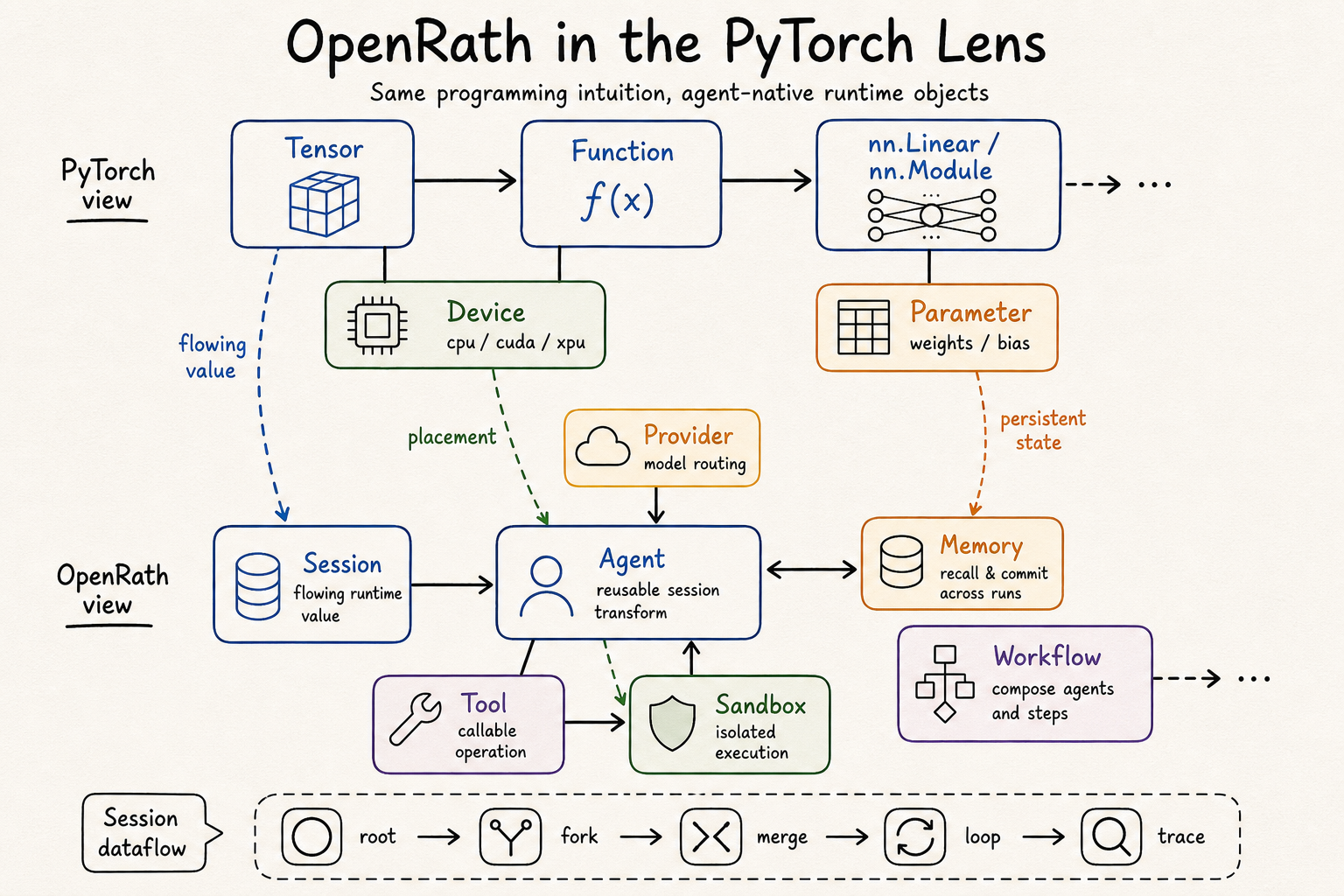
OpenRath borrows PyTorch’s compositional vocabulary for agent runtime state: Session as the flowing value, Backend as placement, Memory as persistent state, Tool as callable operation, and Workflow as composition.#
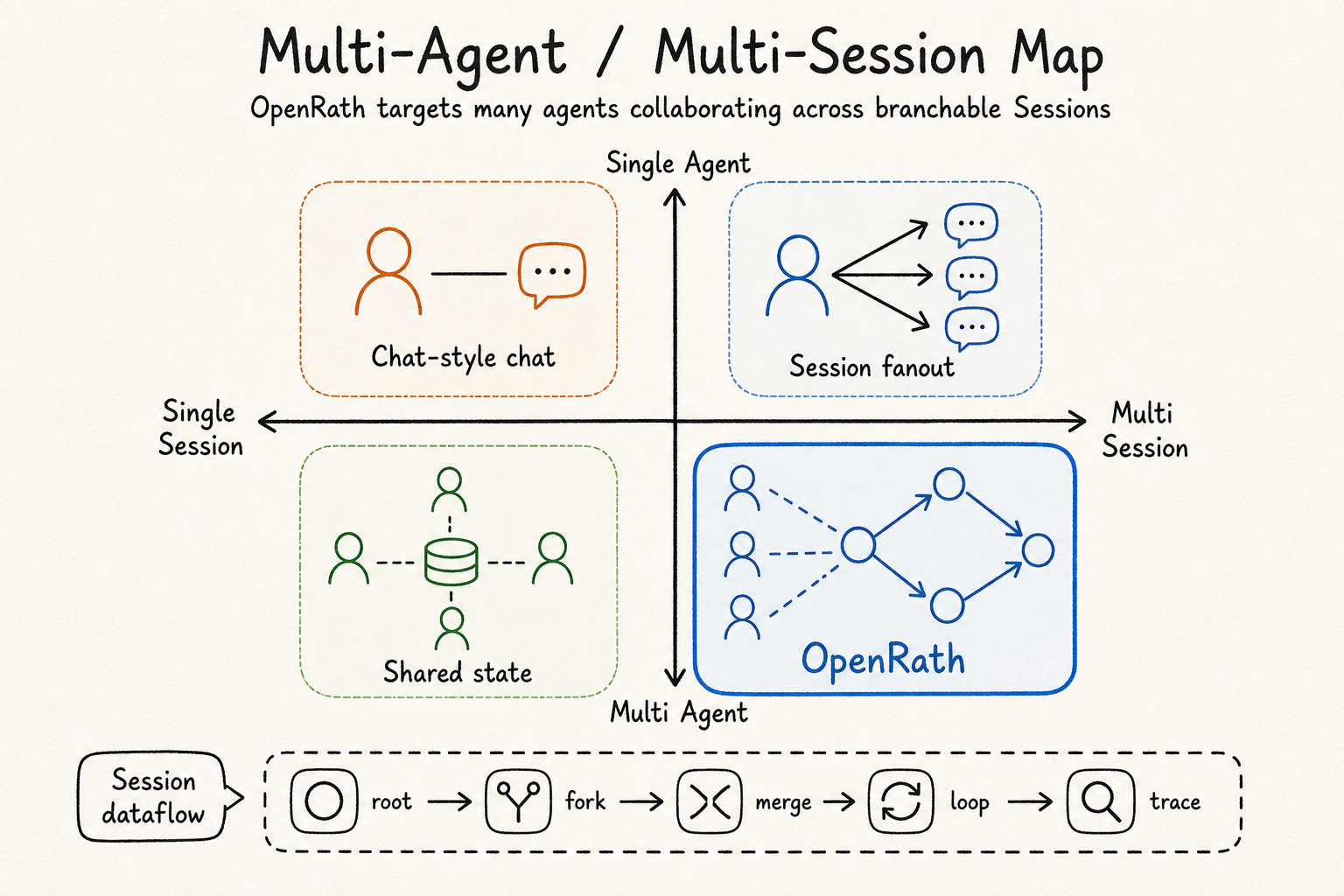
The runtime separates agent composition, session state, backend placement, and memory into explicit surfaces.#
v1-compatible Example Ladder#
Example |
Demonstrates |
|---|---|
The smallest |
|
Fork, detach, session graph, and JSONL export. |
|
Key-free local memory remember / recall / commit. |
|
Swapping OpenAI-compatible and Anthropic providers. |
|
Routing among workflows with |
|
Inspecting and validating a static resource manifest without an API call. |
PyTorch Mental Model#
PyTorch mental model |
OpenRath counterpart |
|---|---|
Tensor carries data |
|
Module composes computation |
|
device controls placement |
|
Parameter persists state |
|
callable module exposes a reusable interface |
|
ordinary control flow selects a module |
|